The history of fat
In 1977, the Senate told America to cut saturated fat. One of them turned out to be essential.
What two dolphin pods, a 1977 Senate committee print and one odd numbered fatty acid have to do with how fast the walls of your cells wear out.

The advice was one line long and it reached 220 million people. Eat less fat. Especially eat less saturated fat, to lower your risk of heart disease.
It worked, in the sense that people listened. Whole fat milk intake in the United States fell four fold in a little over twenty years. Skim milk and low fat alternatives took the shelf space. Butter became something you apologized for.
There was one problem with the advice, and it was not a small one. The evidence available in 1977 never supported it. A study published in 2015 went back to the trials that existed at the time and found that eating less fat had never been proven to help heart health.
That is the part of the story most people have heard by now. This is the part they have not: while America was removing saturated fat from the grocery list, it removed one specific molecule along with it. Not a category. A molecule, fifteen carbon atoms long, that a team of scientists would spend the next four decades proving your cells cannot make in the amounts they need.

What changed on the shelf
Whole fat milk intake in the United States, drawn to the ratio fatty15 publishes: a four fold decrease in just over twenty years. The bars show the ratio, not absolute volumes.
Saturated turned out to be too blunt a word
Fatty acids are named for how many carbon atoms they carry. That number is not decoration. It changes how your body handles the molecule.
The saturated fats that earned the reputation are the even numbered ones. C16:0, palmitic acid, is the textbook example: more of it in the diet is associated with inflammation, heart disease and type 2 diabetes.
The odd numbered ones behave differently. C15:0, pentadecanoic acid, fifteen carbons long, is the one this story is about. Higher levels of it in the body have been associated with balanced immunity, heart health, healthy metabolism, red blood cell health, liver health and gut health.
Same family. Opposite associations. One word covered both for forty years.
Even chain and odd chain
One carbon apart. The even chain is the one associated with inflammation, heart disease and type 2 diabetes. The odd chain is the one associated with the opposite. Diagram drawn from the comparison fatty15 publishes on its science page.
The part that starts with dolphins
Stephanie Venn-Watson is a veterinary epidemiologist. Before any of this she tracked disease outbreaks for the Centers for Disease Control and Prevention and for the World Health Organization. She spent two decades studying the health of bottlenose dolphins, including at the US Navy's marine mammal program.
Dolphins are a strange and useful mirror. They live a long time, they are social and intelligent, and they develop aging related conditions that look a lot like ours.
Her team looked at two populations. One in San Diego, California. One in Sarasota, Florida. Both were generally healthy. But the California group had more aging related conditions, and those conditions are the same ones that precede diabetes, heart disease and stroke in humans.


The difference was on the menu
One variable
The Florida pod ate fish with higher levels of C15:0. So the team changed the California pod's diet to fish with more of it, and watched what happened to the animals and to their cells.
improvement in cellular stability in the California pod after more C15:0 was added to their diet. Their aging related conditions stabilized too.
Figure published by fatty15 on its origin story page.
“When Dr. Stephanie Venn-Watson started studying dolphins at the US Navy's marine mammal program, she wasn't expecting to turn the food pyramid on its head.”
Jessica Rendall, C|net. Quoted on the fatty15 press page.What a fifteen carbon fat actually does inside a cell
You age because your cells do. As they get older their outer membranes get more fragile, and a fragile membrane is a cell that leaks, misfires and breaks down early. The technical name for the damage is lipid peroxidation.
C15:0 is a sturdy fat. It gets built into the membrane itself and sits there as armor. That is the whole mechanism in one sentence, and it is why the company's own shorthand for what it sells is cellular support rather than any particular symptom.
The membrane, with and without
A saturated chain is straight, so it packs tightly and holds its place. That is why fatty15 describes C15:0 as making cells strong where omega-3 makes them flexible. Schematic drawn from the mechanism the company publishes, not a micrograph.
The company puts two numbers on it. Both come from its own published research program.
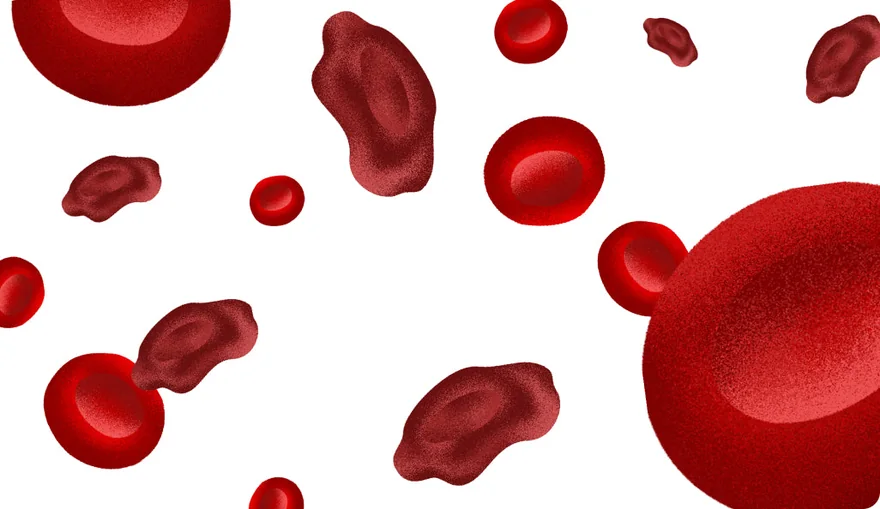
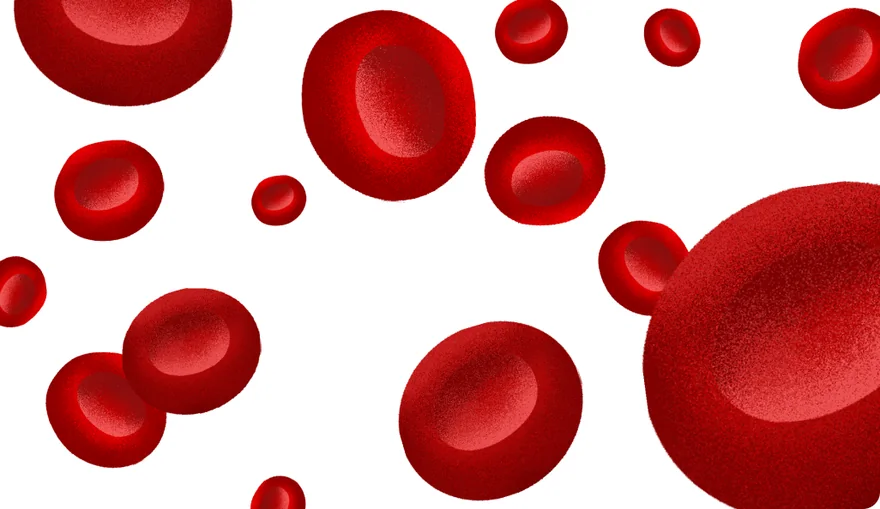
Red blood cells are the easiest place to see the idea, which is why fatty15 illustrates it this way. The company states that C15:0 strengthens red blood cell membranes against oxidative stress and premature breakdown.
Mitochondria, and the receptors nobody talks about
The membrane is only the first floor. Mitochondria weaken with age, which means less energy out of each cell and more stress inside it. fatty15 states that C15:0 helps repair mitochondrial function, with studies in human cells behind the claim.
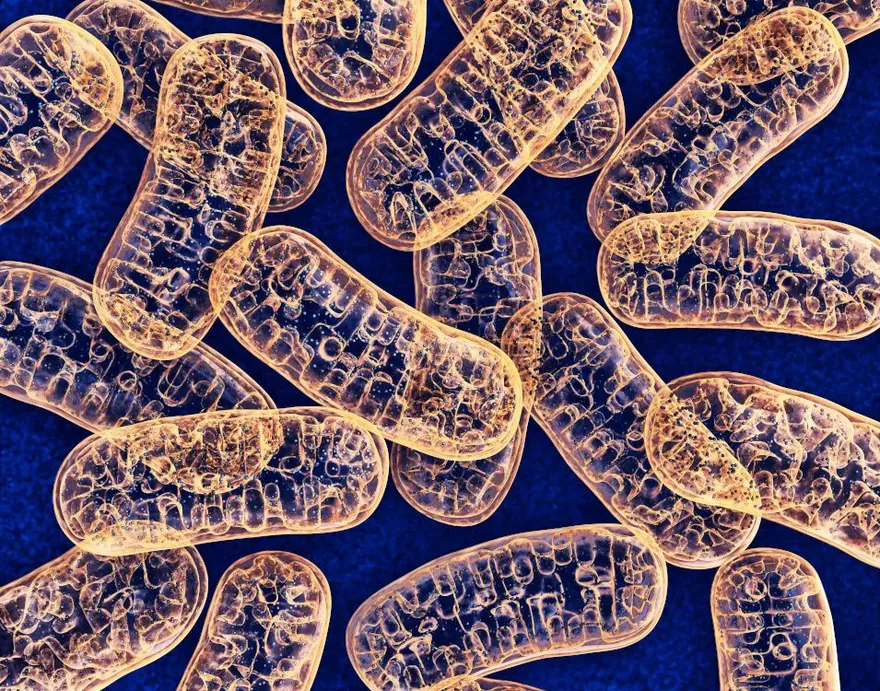
Then there are the PPARs, the peroxisome proliferator activated receptors. They sit throughout the body and orchestrate metabolism and immunity, and they are present in the brain as well, where they take part in regulating mood, sleep and appetite. C15:0 binds to them naturally. It also activates AMPK and AKT on the metabolic side, and the company reports that it inhibits more than eighteen pro inflammatory cytokines.
That list is the reason the marketing sounds vague. A molecule that works at the level of the membrane does not have one symptom to point at. It has a floor that everything else stands on.
fatty15 calls the deficiency Cellular Fragility Syndrome: the idea that low C15:0 leaves membranes weak, and that the weakness shows up as the ordinary complaints of getting older. The term has been picked up in trade coverage by NutraIngredients, Longevity.Technology and WorldHealth.Net, all linked from the company's own press page.
Why eating better does not close the gap
The obvious objection is the right one. If C15:0 is in whole milk, butter, cheese and fish, why not just eat those?
Because of what it comes packaged with. In food, C15:0 arrives mixed with much higher levels of pro inflammatory fatty acids, which is the company's own answer to the question and the reason the supplement exists as a pure ingredient rather than a dairy extract.

“For decades there has been a war on fats such as butter, whole milk, and cheese. But for the first time in 90 years, a San Diego company made an amazing discovery of a new fat, present in butter, and one your body desperately needs.”
Steve Atkinson, abc10. Quoted on the fatty15 press page.It is not doing omega-3's job
This is where most people place it wrong. C15:0 is not a competitor to fish oil. The two are chemically opposite and they do opposite things to a membrane.
Omega-3
- Polyunsaturated
- Fish or algae oils
- Makes cells flexible
- Less stable, more prone to oxidation with age
- 2,000 to 3,000 mg a day
C15:0
- Saturated, odd chain
- One pure ingredient, no taste or smell
- Makes cells strong
- Sturdy, protects against lipid peroxidation
- 100 mg a day
fatty15's position is that both are essential and that they belong together, not that one replaces the other. The company does add one head to head result: tested against pure EPA, it reports three times more cellular benefits relevant to immune, metabolic, heart and liver health.
The dose gap is the part worth sitting with. Twenty to thirty times less material, because a structural fat does not need volume, it needs to be in the wall.
The people who found it

Stephanie Venn-Watson, DVM, MPH
Co-founder and Co-CEO
Veterinary epidemiologist and public health scientist. Formerly an epidemiologist tracking disease for the CDC and the World Health Organization. Co-founder of the National Marine Mammal Foundation. Holds over 40 patents and 70 peer reviewed publications, and received the Department of Health and Human Services Secretary's Award for Innovations in Health Promotion and Disease Prevention.
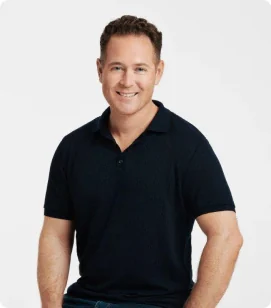
Eric Venn-Watson, MD, MBA
Co-founder and Co-CEO
Practicing physician. Served more than 25 years as a Navy and Marine Corps physician, with combat deployments to Iraq and Afghanistan, working with the special forces community on health and fitness. Has founded companies in drug discovery, healthcare analytics and medical devices.
They are married, they run the company together, and the research program behind it ran for more than ten years, including a decade of collaboration with the US Navy. The company they built to hold it, Seraphina Therapeutics, now lists more than 100 peer reviewed studies, more than 60 patents and more than 30 awards.
“This discovery may elevate C15:0 to the ranks of now hallowed essential fatty acids omega-3 and omega-6 as well as usher in a new dialogue on changing the global guidelines for intake of dietary saturated fatty acids.”
Karen Raterman, New Nutrition Business. Quoted on the fatty15 press page.What you can actually buy
One capsule. 100 mg of FA15, their pure pentadecanoic acid powder, in vegetable cellulose. No taste, no smell, no fish burps. It is the first C15:0 supplement there was.
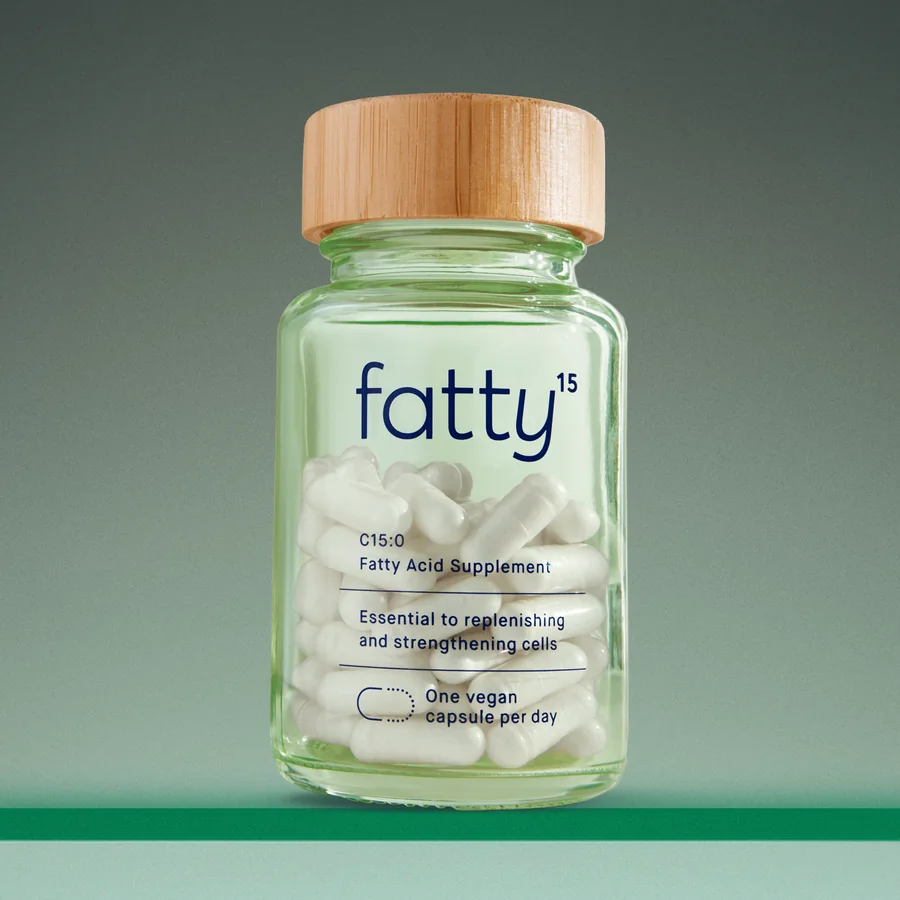
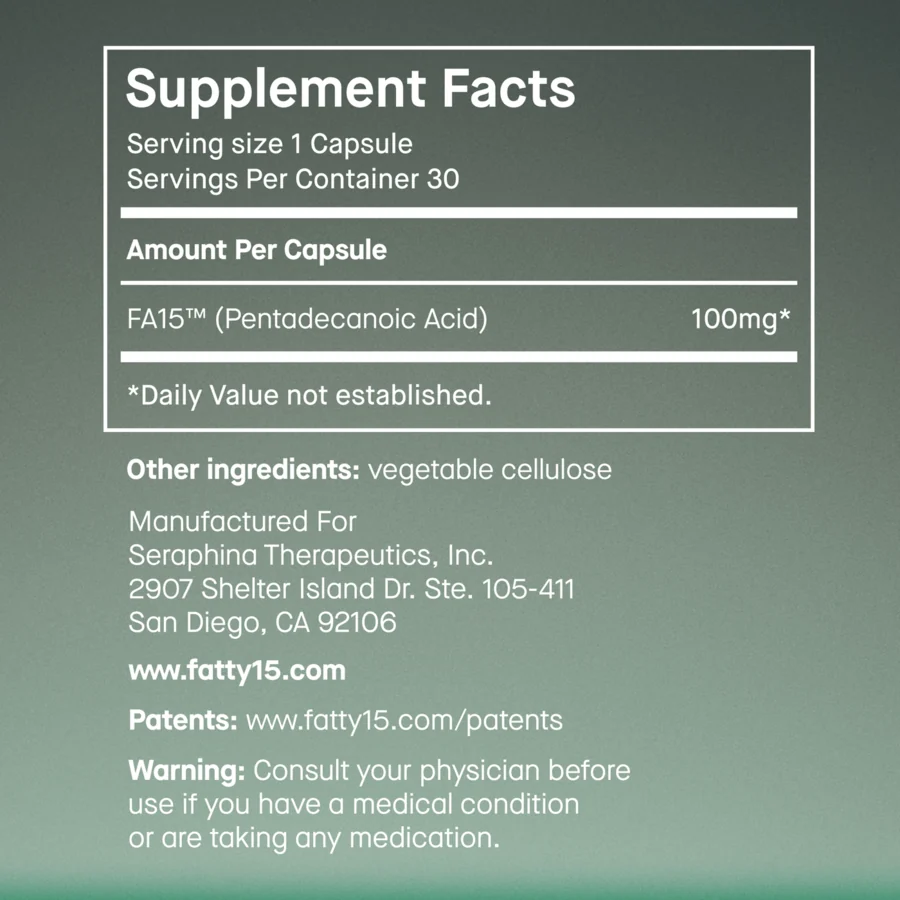
C15:0 is GRAS, generally recognized as safe, which is why the company states it is suitable for children from age four, for pregnant women and for nursing mothers, and not for infants and toddlers.
What it costs
Free shipping on every US order, HSA and FSA eligible, cancel any time, and a 30 day money back guarantee. Subscription refills ship every 90 days.
Prices and terms as published on fatty15.com on August 13, 2026.
What people report after taking it
The number the company leads with comes from a survey of 6,243 of its own customers: 70 percent reported seeing or feeling a benefit within 16 weeks, most often deeper sleep, more energy and a steadier mood. Across 6,367 reviews on the product page the rating sits at 4.9 out of 5, and 98 percent of reviewers say they would recommend it. The company reports more than 100,000 active subscribers.
Sixteen weeks is the part to take seriously. This is a structural nutrient, not a stimulant. Here is what that looks like in the reviews people actually left, quoted as written.
Sleep returned almost instantly.
“I haven't been able to sleep for a long long while. Go to bed, sleep two hours wake up and toss and turn the rest of the night. Drag through the day. Started these and instantly I slept through the night but still every time I sat down. I figured I was getting the makeup rest I needed. Then, after a week, I decided to take them at night. That did the trick. Sleep through the night, not through the day. Nice deep restful sleep.”
Great supplement
“I've been taking for s few days now and I feel more energy, also my sleep has improved, highly recommend.”
Notable improvements and benefits
“Having more energy and less sleepy during the day.”
Noticing some changes
“I've generally been feeling pretty good. I have energy throughout my work day. I'm still tired in the evenings. I don't know if my sleep has improved. Hunger level seems about the same.”
That last one is a three star review and it is on the page on purpose. Out of 6,367 reviews, 47 are one star. The honest read of the whole set is that most people notice something in the first few months and some people notice nothing.
You can check your own level
This is the unusual part for a supplement. C15:0 is measurable. Any doctor can order a fatty acid panel that includes it, and the company partnered with Genova Diagnostics on an at home C15:0 test, so the deficiency it describes is something you can put a number on before and after rather than take on faith.
Ninety years between two discoveries
The last time science added a fatty acid to the essential list, it was omega-3, and it was more than ninety years ago. The claim that C15:0 belongs on that list is what all of this rests on, and it is why the trade press keeps using the word essential in headlines about a San Diego company most people have never heard of.
You do not have to accept the claim to notice the shape of the story. A government told a country to cut a category of food. The category was not one thing. The molecule that went missing had a job, and it took a dolphin population and forty years to find out what the job was.
“Found in certain fish and plants, as well as milk and butter, [C15:0] is believed to improve immune function and strengthen heart health. Some experts hail the substance as even having anti-aging properties.”
Ariana Eunjung Cha, The Washington Post. Quoted on the fatty15 press page.30 day money back guarantee · free US shipping · cancel any time
More on the research, the dolphins and the patents on the company's own pages: the science, the origin story.